
One of the most universal stories a filmmaker can tell is the coming-of-age dramedy: a story about someone, or a group of people, transitioning into a new stage of their lives. More often than not, these films follow teenagers as they navigate the awkward transition into young adulthood. However, plenty of filmmakers have also used the genre to explore adults entering a new era of their lives. It’s one of the most diverse and versatile genres in cinema. So, how do you continue to reinvent a genre as familiar as the coming-of-age story while keeping it relevant? You make it feel so lived-in that it becomes tangibly real, as Marine Atlan does with La Gradiva.
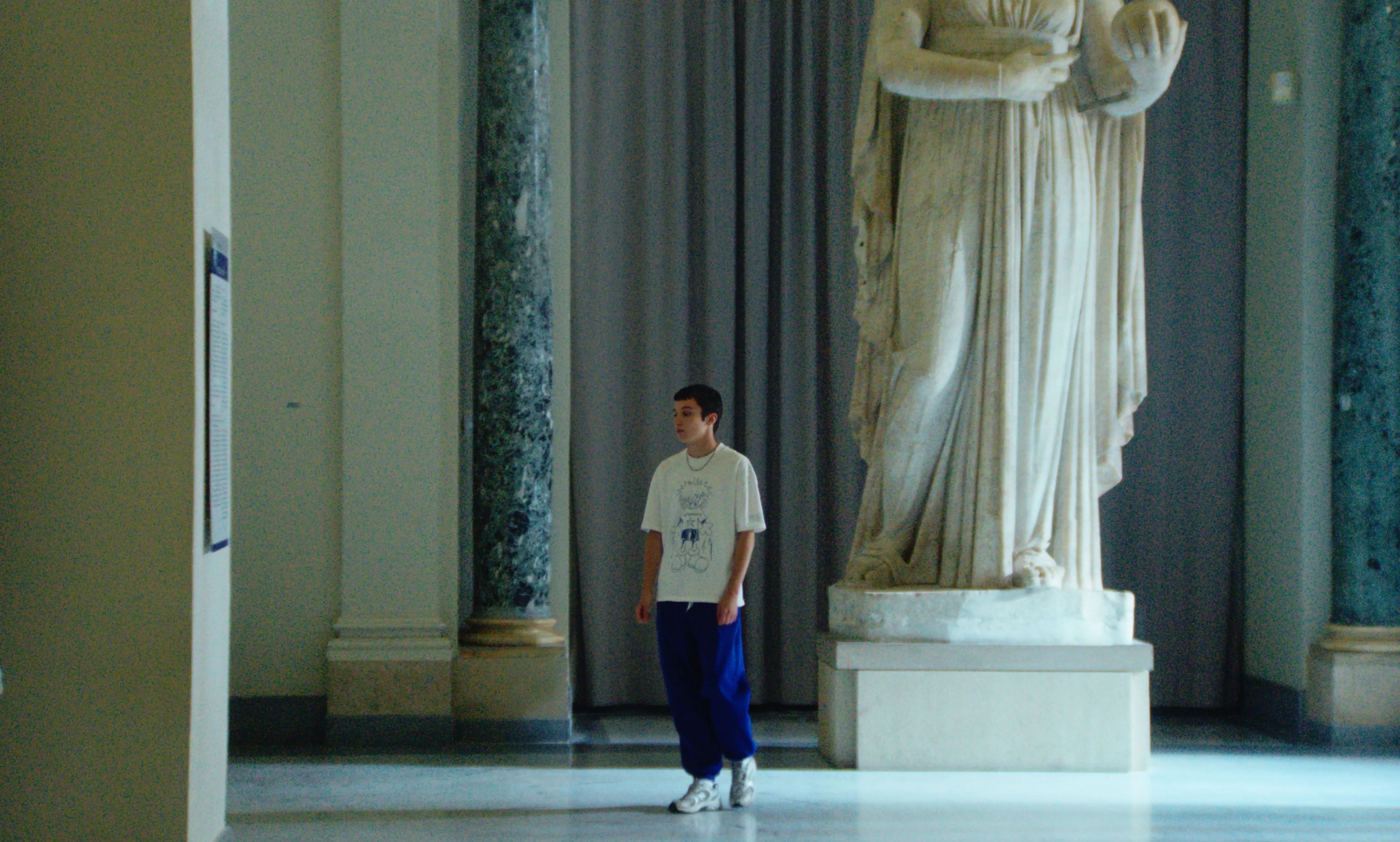
Narratively speaking, La Gradiva is incredibly simple. We follow a group of students on a field trip to Naples, Italy, just weeks before they graduate high school. They are rebellious, rambunctious, anxious, and horny as they prepare to enter a new era of their lives. Deep down, they’re a little frightened, but with their friends by their side, they feel ready to open this new door. While the premise itself isn’t particularly groundbreaking, what makes La Gradiva so original are its characters and the relationships they share with one another. Over the course of nearly three hours, we become intimately familiar with these young people, their insecurities, desires, and fears, ultimately uncovering a film that is far richer thematically than its simple premise might suggest.
We follow three students, the first of whom is Toni, played brilliantly by Colas Quignard. He’s characterized as a misunderstood, rebellious student who seems to struggle with even the simplest instructions. Rather than paying attention to the history of Naples and Pompeii, Toni is far more interested in getting laid and uncovering his family roots.
The second student we meet is James (Mitia Capellier-Audat), Toni’s best friend. Like Toni, James is a rebellious student who is more interested in sleeping with every female student in the class than actually paying attention. At the very least, however, he’s willing to do his homework and get things done to keep their teacher, Madame Mercier (Antonia Burresi), off his back.
The final student we meet is Suzanne (Suzanne Gerin), an incredibly talented and brilliant student who is sadly misunderstood because of how shy and quiet she is. She sees herself as invisible and would rather spend her days left alone, drawing and soaking up the rich history of the region.

Over the course of the film, these three students form an unlikely friendship. And as the class goes from one historical site and art museum to the next, we slowly learn more and more about these characters. We learn their wants, their needs, their desires, their biggest insecurities, and the things they are most ashamed of. What makes these revelations work so well is that they never feel forced. They come naturally through conversations and social interactions that feel exactly like the kind of conversations you would expect to hear from teenagers. It is this naturalness that makes La Gradiva work so incredibly well.
The entire structure of La Gradiva essentially runs on “people talking in rooms” for nearly three hours. And somehow, this creates an atmosphere that feels incredibly lived-in. At times, it feels almost painfully real. Utilizing long takes, some lasting more than 15 minutes, Atlan simply allows us to sit with these characters as they talk, argue, joke, flirt, and interact with one another. Whether they are listening to a lecture about the art of Pompeii or sitting down for dinner while a wedding takes place in the background, we feel completely immersed in their world. And with every conversation, we uncover another small piece of who these characters are.
Director Marine Atlan’s direction is just as natural as the film’s story. She simply follows these characters throughout their field trip, almost as if we are eavesdropping on their conversations. They talk about girls, family history, sex, their futures, or how annoying their teacher is. Whatever the subject may be, their conversations feel painfully real. And when gossip begins to spiral out of control, even the smallest comment can suddenly carry seismic weight.

Shot on 35mm film, La Gradiva also looks gorgeous against the Italian landscape. There is something incredibly vivid yet faint about the cinematography, giving the film the hazy quality of a memory or a dream about a time in your life that you can’t quite return to. It feels like we aren’t simply watching these teenagers experience one of the final moments of their childhood; we are remembering it alongside them.
Overall, La Gradiva is one of the best films of the year. What initially appears to be a simple coming-of-age story becomes something much richer: a film about entering a new era of your life, the friendships we form in our youth, and how even the smallest of comments can carry devastating consequences. Marine Atlan perfectly captures the terrifying uncertainty of being a teenager on the cusp of adulthood. You’re leaving behind everything you’ve known, saying goodbye to people who have shaped you, and stepping through a door without having any idea what is waiting on the other side. You don’t know where you’re going, what you’re going to do, or even who you’re going to become. And that uncertainty is what makes La Gradiva so incredibly powerful. It understands that growing up isn’t about suddenly having all the answers. Sometimes, it’s simply about being brave enough to walk through that door and see what happens next.
My Rating: A
La Gradiva comes to theatres December 11th.
La Gradiva had its North American premiere at the 2026 Toronto International Film Festival.



Leave a Reply